Post
Fishing Hooks Explained: Selecting the Perfect Hook for Every Catch
Jun
Fishing Hooks Explained: Selecting the Perfect Hook for Every Catch
Introduction
Among all the components of a fishing setup, the hook is arguably the most important. While rods, reels, lines, and lures help anglers locate and attract fish, it is the hook that ultimately secures the catch. A perfectly presented bait means little if the hook fails to penetrate properly or hold the fish during the fight. For this reason, understanding fishing hooks is essential for anglers of all skill levels.
Modern fishing hooks are available in countless shapes, sizes, materials, and designs. Each hook style is engineered for specific fishing techniques, target species, bait presentations, and environmental conditions. Whether you’re targeting bass in freshwater lakes, trout in rivers, catfish in reservoirs, or powerful saltwater species offshore, selecting the right hook can significantly improve hook-up rates and landing success.
Choosing the correct hook involves understanding several factors, including hook size, shape, wire thickness, point design, barb style, and intended use. By matching the hook to the bait, fish species, and fishing technique, anglers can increase efficiency, reduce missed strikes, and improve overall fishing performance.
This comprehensive guide explains the most common types of fishing hooks, how they work, and how to choose the perfect hook for every fishing adventure.

Why Fishing Hooks Matter
The hook is the direct connection between the angler and the fish.
Even the best rod, reel, and lure cannot compensate for an inappropriate hook selection.
Benefits of Choosing the Right Hook
Better Hook-Up Ratios Fishing Hooks Explained
Convert more bites into catches.
Improved Fish Retention
Reduce lost fish.
Better Bait Presentation
Increase natural movement.
Enhanced Fishing Efficiency
Maximize opportunities.
The right hook can significantly improve fishing success.
Understanding Fishing Hook Anatomy
Before selecting a hook, it’s important to understand its main components.
Hook Point
The sharp tip that penetrates the fish’s mouth.
Barb
The small projection behind the point that helps prevent fish from escaping.
Bend
The curved section that determines hook shape.
Shank
The straight section between the eye and bend.
Eye
The loop used to attach fishing line.
Understanding these parts helps anglers choose the most appropriate hook design.
Fishing Hook Sizes Explained
Hook sizing often confuses beginners.
Hooks are generally categorized using two numbering systems.
Standard Sizes
Examples include:
- #12
- #10
- #8
- #6
- #4
- #2
- #1
As the number decreases, the hook becomes larger.
Aught Sizes
Examples include:
- 1/0
- 2/0
- 3/0
- 4/0
- 5/0
- 6/0
As the aught number increases, the hook becomes larger.
Selecting the proper size depends on bait size and target species.
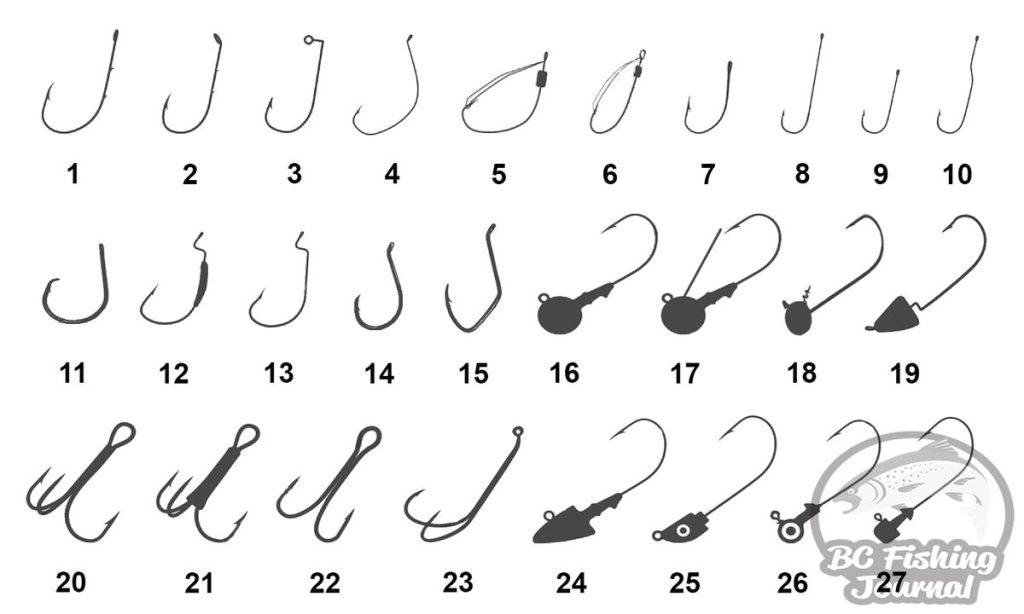
J-Hooks
J-hooks are the most traditional and widely used fishing hooks.
Their shape resembles the letter “J.”
Advantages
Versatility
Suitable for many fishing styles.
Strong Hook Penetration
Reliable performance.
Wide Availability
Found in countless sizes.
Best For
- Live bait
- Artificial lures
- Freshwater fishing
- Saltwater fishing
J-hooks remain a staple in tackle boxes worldwide.
Circle Hooks
Circle hooks feature a curved point that turns inward toward the shank.
Benefits
Higher Hooking Efficiency
Often hook fish in the corner of the mouth.
Reduced Deep Hooking
Improve fish survival.
Excellent for Catch-and-Release
Support conservation efforts.
Best For
- Saltwater fishing
- Live bait presentations
- Catch-and-release fishing
Circle hooks are increasingly popular among conservation-minded anglers.
Treble Hooks
Treble hooks consist of three hook points joined together.
Advantages
Increased Hooking Opportunities
Multiple points improve contact.
Effective on Artificial Lures
Common on crankbaits and topwater lures.
Strong Fish Retention
Reduce escape chances.
Best For
- Crankbaits
- Spoons
- Topwater plugs
Treble hooks are widely used in lure fishing.
Worm Hooks
Worm hooks are specifically designed for soft plastic baits.
Benefits
Weedless Presentation
Reduce snagging.
Secure Bait Placement
Improve durability.
Versatile Rigging Options
Support various techniques.
Best For
- Soft plastic worms
- Creature baits
- Crawfish imitations
Bass anglers frequently rely on worm hooks.
Octopus Hooks
Octopus hooks feature a short shank and wide gap.
Advantages
Excellent Bait Presentation
Ideal for live bait.
Strong Hooking Performance
Reliable penetration.
Compact Design
Suitable for multiple species.
Best For
- Trout
- Salmon
- Walleye
- Panfish
Octopus hooks are highly versatile.
Baitholder Hooks
Baitholder hooks include small barbs along the shank.
Benefits
Secure Bait Retention
Keep bait in place.
Improved Presentation
Reduce bait slippage.
Easy to Use
Popular among beginners.
Best For
- Worms
- Minnows
- Natural bait presentations
Baitholder hooks simplify live bait fishing.
Single Hooks vs Treble Hooks
Both designs offer unique advantages.
Single Hooks
Advantages:
- Easier fish release
- Reduced injury
- Better for catch-and-release
Treble Hooks
Advantages:
- Higher hooking potential
- Effective with reaction baits
Selection depends on fishing goals and techniques.
Barbed vs Barbless Hooks
This choice often depends on regulations and personal preference.
Barbed Hooks
Benefits:
- Improved fish retention
- Reduced escape rates
Barbless Hooks
Benefits:
- Easier hook removal
- Less fish injury
- Faster catch-and-release
Many conservation-focused fisheries encourage barbless hooks.
Freshwater Hook Selection
Different freshwater species require different hook styles.
Bass
Popular choices:
- Worm hooks
- Offset hooks
- Wide-gap hooks
Trout
Popular choices:
- Octopus hooks
- Small J-hooks
Catfish
Popular choices:
- Circle hooks
- Heavy-duty J-hooks
Matching hooks to species improves performance.
Saltwater Hook Selection
Saltwater environments require stronger materials.
Important Features
Corrosion Resistance
Handle saltwater exposure.
Heavy-Duty Construction
Manage larger fish.
Strong Hook Points
Improve penetration.
Popular Saltwater Hooks
- Circle hooks
- Octopus hooks
- Live bait hooks
Durability is especially important in saltwater fishing.
Hook Material and Construction
Quality materials influence performance and longevity.
Common Materials
High-Carbon Steel
Strong and sharp.
Stainless Steel
Excellent corrosion resistance.
Alloy Steel
Balances strength and durability.
Higher-quality materials generally improve reliability.
Choosing Hook Strength
Hook strength should match target species.
Light-Wire Hooks
Advantages:
- Better penetration
- Ideal for finesse fishing
Heavy-Wire Hooks
Advantages:
- Greater strength
- Suitable for powerful fish
Matching hook strength prevents failures.
How Hook Shape Affects Performance
Hook shape influences:
- Penetration
- Holding power
- Bait presentation
Different designs excel in different situations.
Experimentation often helps determine preferences.
Common Hook Selection Mistakes
Avoid these common errors:
Using Hooks That Are Too Large
Can reduce bites.
Choosing Hooks That Are Too Small
May lose larger fish.
Ignoring Target Species
Different fish require different designs.
Overlooking Hook Sharpness
Sharp hooks improve performance significantly.
Attention to detail increases success rates.
Maintaining Fishing Hooks
Proper maintenance extends hook lifespan.
Maintenance Tips
Rinse After Saltwater Use
Prevent corrosion.
Inspect Hook Points
Check sharpness regularly.
Replace Damaged Hooks
Avoid equipment failures.
Store in Dry Conditions
Reduce rust formation.
Well-maintained hooks perform more reliably.
Technology and Innovation in Modern Fishing Hooks
Hook manufacturers continue introducing new technologies.
Recent innovations include:
Chemically Sharpened Points
Improve penetration.
Corrosion-Resistant Coatings
Extend lifespan.
Specialized Hook Shapes
Enhance performance.
Ultra-Strong Alloys
Increase durability.
These advancements continue improving fishing success.
Long-Term Benefits of Choosing the Right Hook
Selecting the proper hook can help anglers:
Catch More Fish
Improve hook-up ratios.
Reduce Lost Fish
Increase landing success.
Protect Fish
Support responsible catch-and-release.
Improve Overall Efficiency
Enhance fishing performance.
The right hook contributes directly to a better fishing experience.
Conclusion
Fishing hooks are the foundation of every successful catch, making proper hook selection one of the most important skills an angler can develop. From J-hooks and circle hooks to treble hooks, worm hooks, octopus hooks, and baitholder hooks, each design serves a specific purpose and performs best under certain conditions.
By understanding hook sizes, materials, shapes, strengths, and applications, anglers can make informed decisions that improve bait presentation, increase hook-up rates, and enhance fish retention. Whether fishing freshwater lakes, rivers, coastal waters, or offshore environments, selecting the perfect hook for the target species and technique can significantly increase fishing success.
A well-chosen hook is more than just a small piece of terminal tackle—it is the critical link between opportunity and achievement, helping anglers land more fish and enjoy every fishing adventure to the fullest.
